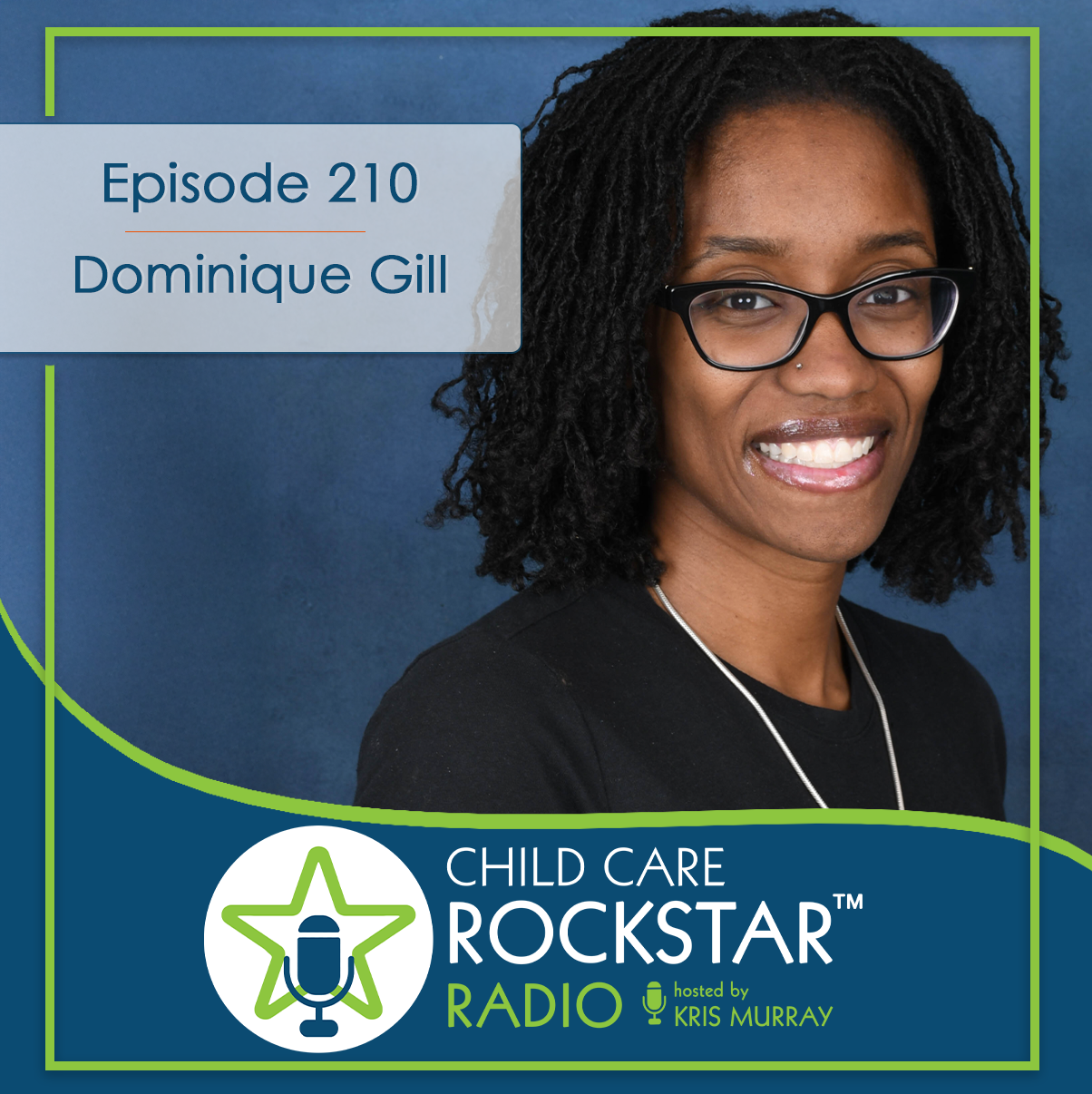
In this heart-filled episode of Child Care Rockstar Radio, Kris Murray sits down with Academy member Dominique Gill, owner of Unique Kids Childcare Centers in Nashville and Smyrna, Tennessee, to share her inspiring journey from teen mom to thriving multi site child care owner. Dominique opens up about how she went from running an in home program to building two full centers, the mindset shifts that helped her grow as a leader, and how she overcame her fears around raising rates, managing staff, and setting boundaries. You’ll hear how she built a warm, family centered culture rooted in celebrating every child’s uniqueness and how the support of the Child Care Success Academy helped her gain the confidence to lead, expand, and create a legacy for her nine children.
Now also streaming video recorded versions of each episode on YouTube! Visit our channel, The Child Care Success Company, and make sure to subscribe so you never miss a new recording!
Click here to listen to more episodes of Child Care Rockstar Radio™ with Kris Murray!
Below you can read the full episode:
Kris Murray:
Welcome to Child Care Rockstar Radio. I am your host, Kris Murray. Child care leaders around the globe are breaking through challenges, leading the way in innovation, testing new best practices, and impacting children and families in a much more powerful and positive way than ever before. Each week, join me for interviews with early childhood leaders and experts that will leave you inspired to become the next child care rockstar. Now let’s go. This is Child Care Rockstar Radio.
Kris Murray:
Episode 210, featuring Dominique Gill. Welcome back, y’all. I am very excited today to introduce you to my friend Dominique. She is a member of the Child Care Success Academy. She is an owner of a beautiful school in Smyrna, Tennessee. The name of her brand is Unique Kids, and in this episode, you’re going to feel the true heart of someone who really, really loves children. It’s undeniable, it’s palpable. And how her school came about is completely organic. I love her growth journey.
Dominique is a mom of six children. Actually, she is a mother of nine children—she has three of her own, she adopted two, and she’s fostering four. So four plus two plus three—am I doing my math right? Yes, that’s nine children. Holy cow. So of course I had to get the full story on all of that. What an amazing woman, and I just can’t wait for you to meet her.
Here we are in mid-September. We are officially fully into back-to-school season, and I hope that you are doing fantastic with your enrollment. I hope your marketing is bringing you lots of new families. I hope that you are full or close to full, and if you’re not, that is okay too, because we’ve been talking a lot about the fact that our industry is going through a bit of a correction.
Diving into the podcast in recent episodes, you will learn what are some of the trends that have brought us to this place. And my guidance for you is that if you’re feeling stressed, strapped, worn out, and you need some fresh strategies of what’s working now to get your full enrollment rocked and get your full staffing rocked, then you must come to the Child Care Success Summit.
We are close to selling out the ballroom and you’ve got to go now to childcaresuccesssummit.com. We will be talking about what’s going on in the industry with this industry correction—what’s going on with, in some markets, an oversupply and lower demand for child care, and also some people hitting the ceiling of pricing, what’s going on with inflation and what’s going on with you, with your costs inside of your school and how to keep costs low, how to reap a few more points down to your profit margin and make more money in your schools so that you can survive and thrive.
If that all sounds good to you and you’re not registered yet for the Child Care Success Summit, then go now and get your tickets before we sell out. We actually may even be sold out at the time that I’m recording this podcast, so go check it out and I hope to see you there. I will be there for the entire Summit.
I cannot wait to share with you some of the marketing 101 things that I’ve taught since the very beginning as the OG of marketing child care in this country. I started teaching that in 2008, before any other coaches came on the scene to teach about child care marketing. I’ve written two books about it, and that’s what a lot of this podcast has been about.
Regardless, I hope to see you in Atlanta. We have a gorgeous venue and I can’t wait to see you there. Today’s episode is titled, When You Love Kids This Much, Success Comes Naturally, and that’s the vibe that you’re going to feel from Ms. Dominique Gill. She is such a heart-centered leader. She’s a little bit more of an introvert, so I did pull some really good juicy stuff out of her on this episode, and I want to thank her for getting out of her comfort zone, as many of our guests do, to join me on this podcast.
You’re going to learn about what to do when you have staff that show up and they want you to treat them fairly and the same as everybody else in the school. There are some pieces of accountability that come into play in your leadership. Leadership can be extremely challenging in an early childhood environment. I don’t have to tell you that.
You’re going to learn some new aspects for how to navigate the waters of leading teams inside of a child care facility. We’re going to talk about raising prices, we’re going to talk about culture, how to engage your team, how to market your school to get full. Dominique does some great grassroots marketing in her neighborhoods and in her communities, and we’re going to talk about that and so much more in this episode.
Also, Dominique went from home to center. She started out as a family child care business, as many of you have, and she decided she wanted to play a bigger game. She talks about the mindset that was required to go from home to center and how she’s blossomed and bloomed as a growth-mindset-oriented human and leader.
So all of this will be shared coming up, and otherwise I don’t think I have anything else to share. So why wait? Let’s just go there. Thanks guys for tuning in to today’s episode and let’s meet Dominique Gill right now. Let’s go.
Kris Murray:
Welcome back folks. I am very excited to introduce you to my guest today, Dominique Gill. Dominique, how are you?
Dominique Gill:
Hey, I am good. Thanks for having me today.
Kris Murray:
You’re welcome. Thanks for being here. Where are you right now?
Dominique Gill:
Today I am at home and I’m in Nashville, Tennessee.
Kris Murray:
Alright. Tell us more about your program—what you do in this amazing world of early childhood education.
Dominique Gill:
I have two centers. One is in Nashville, one is in Smyrna, Tennessee. We’re just right now in the process of getting the new one open in Smyrna, but the other one’s been there for about seven years and it’s been great. Everything’s been going the way it needs to go.
Kris Murray:
Cool. And how big is the one in Smyrna going to be?
Dominique Gill:
We’re shooting for 99.
Kris Murray:
Okay. That’s a fun capacity number. And how big is your one in Nashville?
Dominique Gill:
We have 50 there.
Kris Murray:
Okay, cool. And tell us a little bit more about your journey. What are some highlights of how you’ve come to be an owner of early learning programs, and how long have you been in the field?
Dominique Gill:
It started really early on. I was a teen parent, so immediately I needed to find daycare, but I just couldn’t afford daycare. So I branched off and did a trade for a trade—my kid comes here, and I’ll come here and work. I did that for at least six years.
When that center moved to another spot, all the parents were like, “Where are you going?” and I was like, “I don’t know. I don’t know what to do. This is all I’ve done.”
So I opened an in-home child care for four years and that was great until there was no room at all. We started branching out to find something bigger, which is where we found our current location for 50.
Kris Murray:
And when was that?
Dominique Gill:
That was right in the middle of COVID. We applied for our license in February of that year. They started inspections, and then they stopped inspections in March—they were like, “No, we’re not coming out anymore.” So we had to stop until September.
Kris Murray:
So then in September—how long did it take you to open? Did you open in September or did it take you a few more months?
Dominique Gill:
We opened in September. They were still trying to license me. We were just going at a slower pace to make sure nobody else was there and maintaining six feet apart. So we did that and then we opened in September.
Kris Murray:
Okay, cool. How long did it take you to get to where you were covering your costs? Maybe not full, but was enrollment a slow journey or a fast journey for you?
Dominique Gill:
Luckily in Tennessee we had the essential workers. So right off the bat, as long as you were an essential worker, the state was paying for all the child care. We were really full. It took about three months, and since then we’ve never had an opening.
Kris Murray:
That’s a good place to be. We talk a lot in the Academy about pros and cons of center sizes. A 50-child center typically fills faster and stays full compared to a 110- or 150-child center. But there’s also economies of scale at larger sites. You can’t scale your leadership team as much at 50, but you can still have a director. Do you also have an assistant director or just a director there?
Dominique Gill:
Right now I’m still the director and I have an assistant.
Kris Murray:
Okay, cool. Tell us a little bit about your family life. What do you love to do personally?
Dominique Gill:
My family life is really big. I had my son when I was 16 and he is now 16. I have two more birth children who are 6 and 4. I adopted two kids and we foster four more kids.
Kris Murray:
Oh wow. You adopted two—how old were they?
Dominique Gill:
Seventeen and fourteen.
Kris Murray:
Teenagers. That’s an amazing contribution. And you’re still fostering four?
Dominique Gill:
Yes. Two are eight, one is nine, and one is seven.
Kris Murray:
They’re all around the same age. You are a very busy lady.
Dominique Gill:
It’s always something to do.
Kris Murray:
I hope you’re figuring out who’s going to help you with all that laundry.
Dominique Gill:
Every Sunday is busy.
Kris Murray:
Chores day. Yeah, you’ve got to get everybody to pitch in if you have that big of a family.
Dominique Gill:
We’re good to go.
Kris Murray:
All hands on deck. I have two children, and the reason I never had more is because of the laundry.
Dominique Gill:
Really?
Kris Murray:
Yes. One for each hand. Plus, I was an older mom. I had my kids at 35 and 39, so there are different seasons in motherhood. You’re a young mom, so you’ve got all that energy.
Dominique Gill:
Yeah.
Kris Murray:
That’s an amazing way to give back. I love that you’re doing that for those children while still working towards building your next location. Tell us a little bit about your brand and what makes your center unique.
Dominique Gill:
Both centers are called Unique Kids Childcare Center. The name comes from my name—Dominique—so “Unique,” and it fits our lives. Our philosophy is “Find your uniqueness in a world of differences.”
We have foster kids, adopted kids, and kids from all over. Sometimes they come from very different places and situations, but they’re still unique.
Kris Murray:
I love that. So celebrating diversity is part of your brand?
Dominique Gill:
Yes.
Kris Murray:
Awesome. Nashville is booming with population, so being in a growing area will help you stay full and expand. What else about your center makes you proud?
Dominique Gill:
It’s very family-oriented. My mom and I are there every day, and other family members work with us. We’ve brought on team members from different races and backgrounds and we make them all feel comfortable.
We’re very supportive. If our teachers have family issues, we make sure they have time to handle them. We want everyone to feel like family.
Kris Murray:
Sounds like a loving and nurturing environment—the opposite of corporate.
Dominique Gill:
Yes, it is. We do have rules, but we’re soft about it. I have a lot of kids myself, so I understand when something comes up last minute. I never want staff to feel like if their child gets sick, they’ll lose their job.
Kris Murray:
That’s great. I’m sure that touches the hearts of your employees.
Kris Murray:
Let’s talk a little more about the culture of your program. You came from a home environment, and so many people I’ve interviewed lately have done the same—home to center, home to center. When you moved to a center, how did you intentionally set up your culture to reflect where you wanted it to be?
Dominique Gill:
It really goes back to the whole family approach. When we were in-home, we had families with us for five years. Those kids have now gone off to school, but we still keep in touch with those families.
Now at the center, we’ve seen how important it is to leave a good impression. Those families are coming back. Some travel 45 minutes to an hour just to bring their new children to us because of how we treated them the first time. That loyalty means a lot.
Kris Murray:
When you become a leader of employees, it’s a big mindset shift. At home you might have just one part-time helper, but at a center you have to lead a team. How did you make that leap into becoming an effective leader?
Dominique Gill:
That was really hard. Honestly, it was hard because at home it was just me and my mom. It was great—everyone loved us.
Then when we opened bigger, we suddenly had a lot of different people and a lot of problems. I remember thinking, “I don’t know if I signed up for this.”
Finding the Child Care Success Company really helped. I didn’t know what I was doing, but I couldn’t admit that to my staff because it would make me look bad. I felt lost.
Being around other people who had the same issues helped me realize I wasn’t alone. The Academy gave me steps. I could work on one thing at a time, master it, and then move on. It didn’t happen overnight, but now it feels like second nature.
Kris Murray:
What’s one thing you built out from the Academy that was a big game changer for you?
Dominique Gill:
Surveys—for both parents and teachers. I thought everybody loved me, but the feedback was humbling.
Kris Murray:
What did you hear that surprised you?
Dominique Gill:
Some said management could be better, which shocked me because I thought it was great. Some wanted vacation time and more pay.
One person said everyone should be treated the same. We realized they were probably talking about the families who had followed us from the home daycare—they got more leniency. That was because I wasn’t being a strong leader. I let the staff and parents kind of run things.
Talking to my pod members helped me fix it. Now I make sure everyone is treated fairly and consistently. I updated our contracts so I could point to them if there was pushback. I’m not naturally confrontational, so having it in writing gave me something to lean on while I built my confidence.
Kris Murray:
Thank you for sharing that. Many child care owners are more avoidant than confrontational, especially at first. The Academy helps you go from people-pleasing to people-leading.
Coach Tamina has a saying: “Treat people fairly, not the same.” You can treat people fairly while acknowledging that not everyone is the same. Your A+ player who always delivers is different from your C player.
Dominique Gill:
That’s true. Some people can take the lead and be your A players, while others need more of a push.
Kris Murray:
Exactly. Some need more observation and structure, and others don’t.
Let’s talk about another tough challenge. You mentioned the surveys, but what’s another time you felt overwhelmed or scared—something big you had to overcome?
Dominique Gill:
It might seem small to others, but raising my prices was huge for me. I didn’t know when, how much, or how to do it. I was scared people would get mad and leave.
It took a lot of hot-seat calls and accountability. My partners kept saying, “Did you do it yet?” and I’d say, “Not yet.” It was so scary to me.
Kris Murray:
That’s very common. How did it go when you finally did it?
Dominique Gill:
No one left!
Kris Murray:
How much did you raise them by?
Dominique Gill:
About $20 a week.
Kris Murray:
And how did that affect your cash flow?
Dominique Gill:
It helped me see it was possible. I didn’t even raise it as much as I should have, but it still made a difference. It showed me that if we go up more, we can have more revenue and not leave money on the table.
Kris Murray:
Especially if you’re full.
Dominique Gill:
Right. We didn’t have any spots to fill, so we had to work with what we had.
Kris Murray:
And if you’re full with a waitlist, you can raise rates and know you’ll refill any spots quickly if someone leaves.
Dominique Gill:
Exactly. I used to think, “This is all I can make,” but now I see there are other ways to grow.
Kris Murray:
Have you done anything else to bring in more revenue, like extra services or birthday parties?
Dominique Gill:
Yes, we do birthday parties, and families can host them at the center. It’s not a huge number, but it adds something.
We also do in-house field trips. We partner with outside companies to come in, and that brings in extra income.
Another thing I didn’t know before was that you can get a percentage from picture days. I used to have picture days but didn’t benefit from them. Now we get a percentage, and I help the photographers sell more pictures to parents because the center gets money on the back end.
Kris Murray:
I love that—those little revenue-generating ideas. Have you looked at your registration and supply fees too?
Dominique Gill:
Yes. We added an annual supply fee. Before, a child could start at six weeks old and be there for five years, and we never charged anything again. Now we collect a supply fee every year because we bring in new supplies every year.
Kris Murray:
A hundred percent. That makes sense.
I forgot to ask—what’s a fun fact about you that not many people know?
Dominique Gill:
A fun fact is that even though I seem friendly, I’m actually really shy. I don’t like to talk to people or do big things. I’ll cheer you on from the sidelines, but I don’t want to be in the spotlight.
Kris Murray:
Wow, I wouldn’t have guessed that!
Dominique Gill:
Please call my kids instead of me!
Kris Murray:
Then props to you for coming on this podcast.
Dominique Gill:
Thank you. I had to build up my confidence, but I did it.
Kris Murray:
You’re doing great. I know it can be nerve-wracking, especially for introverts. But honestly, at our Academy parties, you’re always on the dance floor.
Dominique Gill:
I know! I can’t leave them out there alone.
Kris Murray:
Sometimes I think you’ve pulled me onto the dance floor too.
Dominique Gill:
Probably. I’m like, “Come on, everybody!”
Kris Murray:
If you’re not in the Academy and you’re listening to this, we definitely blow off steam at our quarterly retreats. Being in this industry can be stressful, and we make sure to have fun too.
Dominique Gill:
Yes, it’s really great.
Kris Murray:
Earlier you mentioned accountability. Did you have an accountability partner who helped push you to raise your rates?
Dominique Gill:
Yes. When I joined the Academy in Vegas, my first mastermind was that January or February in Florida.
I hadn’t really talked to many people yet because I didn’t like talking to people. But I sat down at a table, and that’s where I met my accountability partner—Constance.
She just started talking to me, asking where I was from. She’s from Tennessee too. She gave me her card, and I reached out. She remembered everything I said I wanted to do and started checking in on me.
It made me feel like I needed to follow through because now someone was watching. She’s still my accountability partner today.
Kris Murray:
That’s awesome. Constance Cherry has been on this podcast—she’s fantastic. I love her energy. She and Reggie were just at the Empire meeting in Cancun for the first time, which can be intimidating, but I know she had a great time.
Dominique Gill:
She told me all about it.
Kris Murray:
The whole idea of accountability buddies is something I brought into the Academy from one of my first masterminds. I’m so glad it’s helped you.
Kris Murray:
Alright, Dominique, as we wrap up, any final thoughts you want to share with the audience about where you’re headed in your journey?
Dominique Gill:
Right now, everywhere I’m going is where I need to be. I appreciate where I’m going and how I’m getting there, and all the obstacles along the way.
I’m grateful for the company and everybody around me, because without them I don’t know how I’d be able to just get up and keep going. We are headed toward creating legacies for my kids, and that’s my biggest goal.
Kris Murray:
That’s beautiful. Thank you for sharing that, and thank you so much for being here today.
Dominique Gill from Tennessee and Unique Kids Childcare Centers—definitely check her out.
What is your website if people want to find you?
Dominique Gill:
uniquekidscc.org
Kris Murray:
Love it. Are you a nonprofit or just using “.org” to look like one?
Dominique Gill:
Just to look like one. We’re working on setting up a nonprofit though, and some Academy members are helping me with that.
Kris Murray:
That’s a cool strategy. You can attach a nonprofit to your for-profit business—there are different ways to do it.
Awesome. Well thank you so much for being here.
Take care and God bless, everybody. Thanks for tuning in to another amazing episode of Child Care Rockstar Radio. We’ll see you next time.
Dominique Gill:
Thank you.
Kris Murray:
Thank you.
Kris Murray (closing):
I hope you liked this episode of Child Care Rockstar Radio. If you did, please leave a review and share it with someone to help spread the word to friends in our industry and on social media.
Child care business success is my passion and I’m honored to be on this journey with you.
As a thank you for listening, I’ve got a new video training that shows you how to add six figures or more of new revenue to your program in the next 60 days by improving your hiring and your enrollment systems.
To watch my new video, just go to www.fixmyschool.com.